

Introduction:
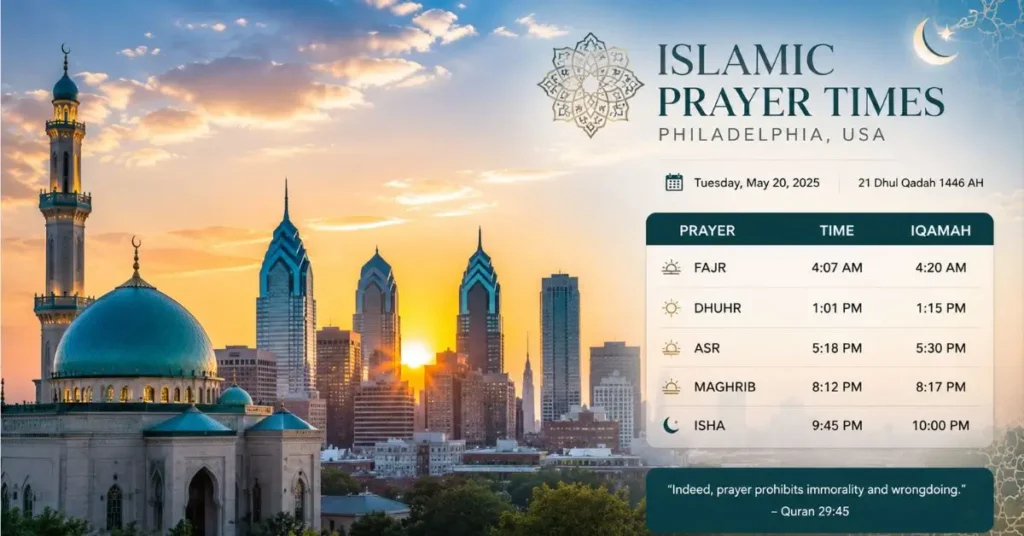
Prayer is one of the five pillars of Islam and forms the foundation of a Muslim’s daily life. Whether you are a lifelong resident, a student, a recent convert, or simply visiting the city, knowing the correct islamic prayer time in philadelphia helps you perform every Salah on time.
Many people search for prayer schedules online but often find only a list of times without understanding why those times change or which source is the most reliable. This guide explains everything in simple language so you can confidently follow your daily prayers while living in or traveling through Philadelphia.
What Is Islamic Prayer Time?
Islamic prayer time refers to the specific period during which each of the five daily prayers must be performed. These times are determined by the position of the sun rather than a fixed clock schedule, which is why they change slightly every day throughout the year.
smmary
- Muslims perform five daily prayers.
- Prayer times are based on the sun’s position.
- Timings change slightly every day.
- Philadelphia follows local astronomical calculations.
- Always verify the daily schedule from a trusted Islamic organization or your local mosque.
- Friday (Jumu’ah) prayer usually follows a separate timetable announced by individual mosques.
Why Prayer Times Change Every Day
Many people wonder why yesterday’s Fajr time differs from today’s.
The answer is simple.
Islam follows a natural system based on the movement of the sun. Because sunrise, sunset, and daylight hours change throughout the year, every prayer also shifts by a few minutes each day.
For example:
- During summer, daylight lasts longer, making Maghrib and Isha later in the evening.
- During winter, the sun sets much earlier, so evening prayers also occur earlier.
This daily variation allows Muslims to worship according to Allah’s natural signs rather than following one fixed yearly schedule.
The Five Daily Prayers Explained
Every Muslim performs five obligatory prayers each day. Each has its own time window and spiritual significance.
| Prayer | When It Begins | Importance |
|---|---|---|
| Fajr | Before sunrise | Starts the day with worship |
| Dhuhr | After the sun passes its highest point | Midday remembrance of Allah |
| Asr | Late afternoon | Encourages reflection before evening |
| Maghrib | Immediately after sunset | Marks the end of the day |
| Isha | After twilight disappears | Ends the day’s worship |
Each prayer has a beginning time and an ending time. Offering Salah within its proper window is an essential part of Islamic practice.
How Islamic Prayer Times Are Calculated
The islamic prayer time in philadelphi is not chosen randomly. It is calculated using well-established astronomical observations that have been used for centuries.
Modern Islamic organizations use advanced software and astronomical data to determine:
- Sunrise
- Sunset
- Solar noon
- Twilight angles
- Geographic coordinates
- Elevation
These calculations provide highly accurate daily prayer schedules for Muslims living in Philadelphia.
Different Islamic organizations may use slightly different calculation methods, which can result in differences of one to five minutes. This is completely normal and widely accepted within the Muslim community.
Which Calculation Methods Are Common?
Several respected organizations publish prayer schedules for cities around the world.
Common calculation methods include:
- Islamic Society of North America (ISNA)
- Muslim World League (MWL)
- Umm al-Qura University
- Egyptian General Authority of Survey
Many mosques in the United States choose the method that best serves their local community.
Because of these differences, your neighborhood mosque may display prayer times that vary slightly from a mobile app. A difference of just a few minutes is generally expected and should not be a cause for concern.
Finding Accurate Prayer Times in Philadelphia
If you’re searching for the most reliable islamic prayer time in philadelphi, remember that today’s schedule should always come from trusted Islamic organizations or local mosques rather than unknown websites.
Reliable sources update prayer times daily using astronomical calculations and recognized Islamic standards.
Many Muslims also use mobile applications that automatically adjust prayer schedules based on their current location, making it easier to stay on time while traveling.
For the best experience:
- Enable location services on your phone.
- Select the correct calculation method.
- Verify your preferred madhhab settings if the app provides that option.
- Compare your app with your local mosque during Ramadan or Jumu’ah if needed.
Why Local Mosques Matter
Although digital apps are convenient, local mosques remain one of the most trusted sources for daily Salah schedules.
Mosques often make small adjustments based on community practice, local observation, or organizational guidelines. They also announce important events such as:
- Ramadan prayer schedules
- Taraweeh timings
- Eid prayer times
- Jumu’ah prayer sessions
- Community gatherings
For new Muslims especially, following the timetable of a nearby mosque helps build consistency and strengthens community connections.
Tips for Never Missing a Prayer
Life can become busy with work, school, family responsibilities, and travel. Fortunately, a few simple habits can help you maintain your daily Salah.
Start by setting prayer reminders on your smartphone. Most Islamic apps allow custom notifications before each prayer begins.
Keep a prayer mat available at home, work, or in your vehicle if appropriate. Preparing in advance removes unnecessary delays.
If you have a demanding schedule, consider planning important meetings around prayer windows whenever possible. Even a short break can provide enough time to perform Salah peacefully.
Many Muslims also find it helpful to review the islamic prayer time in philadelphia each morning so they know exactly when each prayer will begin throughout the day.
Practical Challenges Throughout the Year
Following the islamic prayer time in philadelphi becomes easier once you understand how the seasons affect the daily schedule. Philadelphia experiences noticeable changes in daylight throughout the year, so prayer times shift accordingly.
Summer
During the summer months:
- Fajr begins very early.
- Maghrib and Isha occur much later.
- Longer daylight hours may require adjusting your daily routine.
Many Muslims set multiple alarms for Fajr and plan evening activities around Maghrib and Isha.
Winter
Winter brings shorter days.
This means:
- Fajr starts later than in summer.
- Dhuhr arrives earlier.
- Maghrib may occur before many people finish work.
Checking the daily prayer timetable helps you avoid missing prayers during these seasonal changes.
Prayer While Traveling in Philadelphia
Visitors often wonder how to maintain their Salah routine while exploring the city.
Fortunately, Philadelphia has an active Muslim community with many mosques and Islamic centers.
If you are traveling:
- Check the local prayer schedule before leaving your hotel.
- Carry a small prayer mat if possible.
- Use a reliable prayer time app with location services enabled.
- Locate nearby mosques for congregational prayers.
For example, a business traveler attending meetings downtown can review the day’s Salah timetable in the morning and plan short breaks around Dhuhr or Asr.
Friday (Jumu’ah) Prayer
Friday prayer is different from the regular Dhuhr prayer.
Most mosques offer one or more Jumu’ah congregations to accommodate the community. Since schedules vary by mosque, always confirm the Friday timetable before leaving home.
Many Islamic centers publish their weekly announcements on their official websites or social media pages.
If you’re new to the area, arriving 15–20 minutes early allows time for parking, wudu, and finding a place in the prayer hall.
Benefits of Following Prayer Times Consistently
Praying on time offers more than simply fulfilling an obligation.
Some practical benefits include:
- Builds discipline in daily life.
- Encourages regular remembrance of Allah.
- Creates a balanced daily routine.
- Strengthens connection with the Muslim community.
- Helps reduce distractions by organizing the day around worship.
Many Muslims find that structuring their schedule around Salah improves time management and brings greater peace of mind.
Common Mistakes to Avoid
Many people accidentally make small mistakes when checking prayer schedules.
Avoid these common issues:
Using Outdated Prayer Calendars
Prayer times change every day. Always use an updated daily schedule instead of relying on an old monthly calendar.
Choosing the Wrong Location
Some mobile apps may display timings for another city if location services are disabled.
Always confirm that Philadelphia is selected.
Ignoring Daylight Saving Time
In the United States, daylight saving time changes the clock twice each year. Reliable prayer apps update automatically, but manually entered schedules may not.
Mixing Different Calculation Methods
Small differences between apps and local mosques are normal. Choose one trusted source and follow it consistently.
Helpful Tips for Families
Parents can help children build good prayer habits by creating simple routines.
Ideas include:
- Keep a family prayer timetable on the refrigerator.
- Set gentle reminders before each prayer.
- Pray together whenever possible.
- Teach children the names of all five daily prayers.
- Visit the local mosque regularly.
These habits help children understand the importance of Salah from an early age.
Frequently Asked Questions
What is the best way to check Islamic prayer time in Philadelphia?
The most reliable approach is to use a trusted Islamic prayer app or follow the published schedule of a local mosque. These sources update daily using recognized calculation methods.
Checking your preferred source each morning ensures you have the latest timings, especially during seasonal changes.
Why do prayer times change every day?
Prayer times depend on the position of the sun rather than fixed clock hours. As sunrise and sunset change throughout the year, each prayer begins at a slightly different time.
This natural system has been used throughout Islamic history and remains the standard worldwide.
Which prayer comes first each day?
Fajr is the first obligatory prayer of the day. It begins before sunrise and marks the start of the daily worship schedule.
Many Muslims use alarms or prayer apps to wake up on time for Fajr.
Why are mosque prayer times sometimes different from my app?
Different organizations use slightly different astronomical calculation methods. These variations usually result in differences of only a few minutes.
Following your local mosque’s timetable is generally recommended if you regularly pray there.
Can travelers follow local Philadelphia prayer times?
Yes. Visitors should follow the local prayer schedule for Philadelphia while staying in the city. Most prayer apps automatically update based on your location.
This makes it easy to maintain your Salah routine during business trips or vacations.
Do prayer times change during Ramadan?
Yes. The prayer schedule continues to change daily throughout Ramadan because it follows the movement of the sun.
Mosques also publish separate schedules for Taraweeh prayers, community iftars, and other Ramadan activities.
Final Thoughts
Praying on time is an important part of a Muslim’s daily life. Understanding how islamic prayer time in philadelphi is determined helps you stay consistent throughout the year, whether you live in the city or are only visiting.
Use trusted prayer schedules, stay connected with your local mosque, and make Salah a regular part of your daily routine. Even small habits, like checking the day’s prayer timetable each morning, can make a meaningful difference.
Also read this: