

introduction:
Starting a business without depending heavily on outside investors can give founders more control over their decisions, finances, and long-term direction. This approach is commonly known as bootstrapping a startup or building a bootstrapped startup.
The phrase startup booted is sometimes used online when discussing this type of business. In practical terms, the idea usually relates to a startup that grows primarily through founder resources, customer revenue, and careful reinvestment rather than relying on large rounds of venture capital.
But what exactly does a startup booted model mean? How does it work, how is it funded, and how is it different from a venture-backed startup?
This guide explains the concept, its benefits and limitations, financial considerations, real-world examples, and the situations in which bootstrapping may or may not be the right choice.
What Does Startup Booted Mean?
Startup booted generally refers to a startup that is built and grown with limited reliance on external investment.
The more established term for this approach is bootstrapped startup.
Instead of immediately raising money from venture capital firms or angel investors, a founder may use:
- Personal savings
- Revenue from early customers
- Reinvested business profits
- Pre-orders
- Customer deposits
- Small business income
- Grants or other non-equity funding
The goal is to make the business increasingly capable of funding its own operations.
For example, imagine a founder creates a small software product with $10,000 of personal savings. The product attracts its first customers and generates $3,000 in monthly revenue. Instead of raising venture capital immediately, the founder reinvests part of that revenue into hosting, product development, marketing, and customer support.
That is the basic principle behind a bootstrapped business.
Is Startup Booted the Same as Bootstrapped?
The phrases are not equally established.
Bootstrapped startup is the standard business term used to describe a company that relies primarily on internal resources and operating revenue rather than external equity investment.
Startup booted is a less conventional phrase that may appear in searches and online content referring to a similar concept.
For someone researching the topic, understanding the established terminology is important because most startup resources discuss bootstrapping, bootstrapped companies, or self-funded startups.
Startup Booted vs Bootstrapped Startup
| Concept | Meaning |
|---|---|
| Startup booted | An informal phrase associated with building a startup through internal resources |
| Bootstrapped startup | A startup primarily funded through founders and business-generated revenue |
| Self-funded startup | A business initially financed with the founder’s own money |
| Venture-backed startup | A company that receives equity investment from investors |
| Hybrid-funded startup | A company that combines revenue, founder funding, loans, grants, or investment |
Understanding these distinctions can prevent confusion when researching startup funding strategies.
How Does a Bootstrapped Startup Work?
A bootstrapped startup generally follows a revenue-focused cycle:
Build → Launch → Acquire Customers → Generate Revenue → Reinvest → Grow
The founder tries to keep the business financially sustainable while gradually increasing its revenue.
1. Identify a Specific Problem
The process normally begins with a problem that customers are willing to pay to solve.
A founder should avoid spending heavily before confirming that there is genuine demand.
2. Build a Minimum Viable Product
Instead of creating a large product immediately, the founder can start with a minimum viable product (MVP).
The MVP should solve the core problem without unnecessary features.
3. Find the First Customers
Early customers are particularly important for a bootstrapped business because they can provide both revenue and feedback.
A founder may use:
- Direct outreach
- Search engine optimization
- Social media
- Communities
- Referrals
- Partnerships
- Content marketing
4. Reinvest Revenue
When the business begins generating revenue, some of that money can be reinvested.
For example:
Revenue → Operating expenses → Profit → Reinvestment → Growth
The exact allocation depends on the company’s financial situation.
5. Scale Carefully
Bootstrapped founders usually have to think carefully about spending because they cannot assume that another investment round will arrive to cover losses.
This can encourage disciplined hiring, marketing, product development, and cash management.
How Do Startup Bootstrapped Businesses Get Funding?
A bootstrapped startup does not necessarily mean that the founder pays for everything personally forever.
There are several possible sources of capital.
Founder Savings
Personal savings are one of the simplest ways to finance the initial development of a business.
The advantage is that the founder generally does not give away equity to an investor.
However, using personal money also creates personal financial risk.
more go : QuikConsole.com: What It Is and What to Know
Customer Revenue
Revenue can become the most important source of funding once a startup has paying customers.
For example, a SaaS company might use monthly subscription revenue to pay for:
- Cloud hosting
- Developers
- Customer support
- Marketing
- Software tools
- Operations
Pre-Orders
Some businesses can collect customer payments before fully delivering a product.
This can reduce the amount of capital required to start production.
However, founders must be careful to deliver what customers were promised.
Grants
Depending on the business and location, founders may qualify for grants or other non-equity funding.
Grant availability varies significantly, so founders should verify eligibility and current program requirements.
Reinvested Profits
Once a business becomes profitable, the founder can reinvest some or all of the profit into growth.
This is one of the strongest forms of sustainable bootstrapping because growth becomes increasingly connected to the business’s own performance.
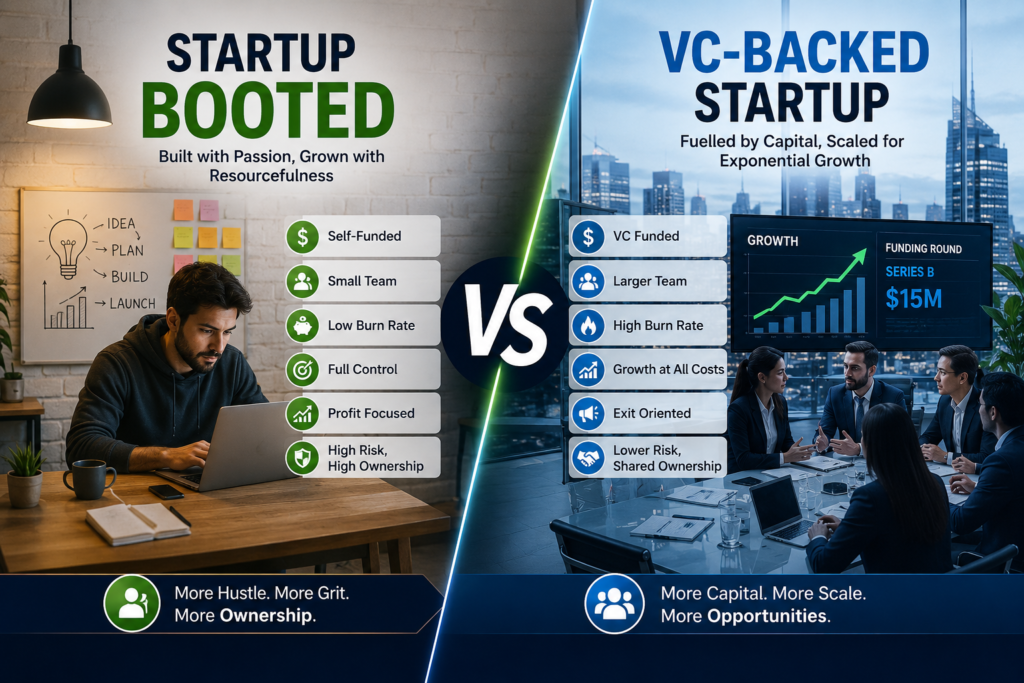
Startup Booted vs Venture-Backed Startup
One of the most important decisions for a founder is whether to bootstrap or seek outside investment.
Neither approach is automatically better.
The right option depends on the business model, market, capital requirements, growth strategy, and founder’s objectives.
| Factor | Bootstrapped Startup | Venture-Backed Startup |
| Primary funding | Founder/revenue | Investors |
| Founder ownership | Usually higher | Can decrease through equity dilution |
| Growth speed | Often more controlled | Can be faster |
| Financial pressure | Cash-flow focused | Fundraising and growth focused |
| Investor involvement | Limited or none | Often significant |
| Decision-making | Usually more founder-controlled | May involve investors/board |
| Capital availability | More limited | Potentially much larger |
| Risk | Founder carries more financial risk | Financial and ownership risks are shared differently |
A founder should therefore choose based on the needs of the business rather than assuming that venture capital is always the next step.
Advantages of a Startup Booted Model
Bootstrapping has several potential benefits.
Greater Ownership
Founders can retain more ownership because they are not automatically exchanging equity for outside capital.
This can provide greater control over important decisions.
More Control
Without external investors, founders may have greater freedom to decide:
- Which customers to target
- Which products to build
- How quickly to grow
- When to hire
- Where to reinvest profits
Financial Discipline
Limited capital can force founders to prioritize expenses.
Instead of hiring a large team immediately, a founder may need to determine which roles are genuinely necessary.
Customer-Focused Growth
When revenue comes directly from customers, founders have a strong incentive to build products that people actually want to purchase.
Less Dependence on Fundraising
A business that can support itself through revenue may not need to spend significant time preparing for repeated investment rounds.
Disadvantages of Bootstrapping
Bootstrapping also has meaningful limitations.
Limited Capital
Some businesses require substantial upfront investment.
Examples may include:
- Hardware startups
- Biotechnology
- Advanced research
- Large infrastructure businesses
- Capital-intensive manufacturing
These companies may find pure bootstrapping difficult.
Slower Expansion
A company with limited capital may not be able to hire quickly, launch in multiple markets, or spend aggressively on customer acquisition.
Founder Financial Risk
If personal savings are used, the founder may carry significant financial exposure.
Missed Opportunities
A company may sometimes encounter a growth opportunity that requires capital immediately.
Without sufficient funds, the business may not be able to take advantage of it.
Founder Burnout
When resources are limited, founders often perform multiple roles.
One person may handle:
- Product
- Marketing
- Sales
- Customer support
- Finance
- Operations
That can become difficult as the company grows.
Startup Booted Financial Modeling
Financial modeling is particularly important for a bootstrapped business because spending decisions are closely connected to available cash and revenue.
A simple startup financial model should consider:
- Revenue
- Cost of goods or services
- Operating expenses
- Payroll
- Marketing costs
- Software expenses
- Cash balance
- Monthly burn
- Profit or loss
- Runway
Example
Suppose a small SaaS startup generates:
Monthly revenue: $12,000
Its monthly expenses are:
- Payroll: $5,000
- Software and hosting: $1,000
- Marketing: $2,000
- Other expenses: $1,000
Total expenses:
$9,000
Estimated operating surplus:
$12,000 − $9,000 = $3,000
Instead of immediately increasing spending, the founder could decide how much of that $3,000 should be retained as a cash reserve and how much should be reinvested.
The numbers above are only an illustration; actual financial decisions depend on the company’s circumstances.
Why Cash Flow Matters
Revenue does not always mean that a company has enough cash available.
For example, a business might have significant sales but still experience cash-flow problems because customers pay invoices weeks or months after receiving a service.
A bootstrapped founder should therefore monitor:
Cash Inflows − Cash Outflows = Net Cash Change
Understanding cash flow can help prevent a profitable-looking business from running out of available cash.
What Is Startup Runway?
Startup runway describes how long a business can continue operating before it runs out of available cash under a given spending scenario.
A simplified formula is:
Runway = Available Cash ÷ Monthly Net Burn
For example, if a company has $60,000 available and is losing $5,000 per month:
$60,000 ÷ $5,000 = 12 months
This means the business has approximately 12 months of runway under those assumptions.
A bootstrapped founder should regularly update the calculation because revenue and expenses can change.
Startup Booted Fundraising Strategy
Bootstrapping does not necessarily mean that a company can never raise money.
A founder may bootstrap initially and seek investment later.
This can happen when the company has:
- Product-market fit
- Paying customers
- Consistent revenue
- Strong growth
- A clear market opportunity
- A need for additional capital
For example, a founder might first build a product using personal savings and customer revenue. After proving demand, the company may raise seed funding to expand into additional markets.
This is sometimes called a hybrid approach.
When Should a Bootstrapped Startup Raise VC?
There is no universal revenue number that automatically means a startup should raise venture capital.
Instead, founders should consider questions such as:
- Is the market expanding quickly?
- Would additional capital create a meaningful competitive advantage?
- Can the company deploy investment efficiently?
- Is the founder comfortable giving up equity?
- Does the business require capital to scale?
- Is there strong evidence of product-market fit?
- Can the company grow sustainably without investment?
If a company can grow profitably without external funding, remaining bootstrapped may make sense.
If competitors are scaling rapidly and additional capital could create a significant advantage, raising investment may deserve consideration.
Examples of Bootstrapped Startups
Several well-known companies have been associated with bootstrapped or largely self-funded growth at different stages of their histories.
Examples commonly discussed in startup literature include:
- Mailchimp
- Basecamp
- Atlassian
- Zoho
However, founders should verify the specific funding history of any company before describing it as completely bootstrapped because companies can change their financing structure as they grow.
The important lesson is not that every successful company should bootstrap.
The lesson is that businesses can sometimes achieve substantial growth by focusing strongly on customers, revenue, profitability, and disciplined spending.
How to Build a Bootstrapped Startup
If you want to build a startup with limited outside investment, the following process can provide a practical starting framework.
Step 1: Find a Real Problem
Start with a problem rather than an idea.
Ask:
Who has this problem?
How frequently does it occur?
Are people already paying for solutions?
Step 2: Validate Demand
Talk to potential customers before investing heavily.
Look for evidence that the problem is important enough for people to spend money solving it.
Step 3: Build a Simple MVP
Develop the smallest useful version of the product.
Avoid spending months creating features that customers have not requested.
Step 4: Get Paying Customers
Revenue provides more useful evidence than simple website visits or social media engagement.
Try to convert early users into paying customers as soon as the product provides genuine value.
Step 5: Track Unit Economics
Monitor metrics such as:
- Customer acquisition cost
- Average revenue per customer
- Gross margin
- Customer retention
- Lifetime value
The exact metrics depend on the business model.
Step 6: Protect Cash Flow
Avoid unnecessary recurring expenses.
Before adding a new cost, ask:
Will this expense help us create, deliver, or sell the product?
Step 7: Reinvest Strategically
Use revenue to improve the areas that can produce measurable business value.
This could include:
- Product development
- Customer support
- Marketing
- Sales
- Infrastructure
Step 8: Decide Whether Outside Funding Is Necessary
Once the business has traction, compare the benefits and costs of remaining bootstrapped with raising capital.
Common Bootstrapping Mistakes
Spending Too Much Before Validation
Building a complex product before confirming demand can consume limited capital.
Hiring Too Early
A large team is not always necessary during the early stages.
Ignoring Cash Flow
Revenue and profit do not automatically mean that cash management can be ignored.
Growing Too Quickly
Rapid growth can increase expenses faster than revenue.
Focusing Only on Revenue
Revenue is important, but founders should also understand margins, retention, cash flow, and customer acquisition costs.
Refusing Outside Funding at All Costs
Bootstrapping should be a strategy, not an ideology.
If outside capital genuinely creates a strong opportunity, refusing it automatically may not be rational.
Is Bootstrapping Right for Every Startup?
No.
Bootstrapping may be particularly attractive for businesses that can:
- Launch with relatively low capital
- Generate revenue quickly
- Maintain healthy margins
- Grow gradually
- Serve a clear customer segment
It may be less suitable for businesses requiring substantial upfront investment or extremely rapid expansion.
The best funding strategy depends on the specific business.
Frequently Asked Questions
What does startup booted mean?
Startup booted is an informal phrase that generally relates to building a startup through internal resources, founder funding, and business-generated revenue. The more established term is bootstrapped startup.
What is a bootstrapped startup?
A bootstrapped startup is a company that primarily relies on founder resources and revenue generated by the business instead of depending on external equity investment.
Is a bootstrapped startup self-funded?
It can be, particularly during its early stages. However, bootstrapped businesses may also use customer revenue, pre-orders, grants, or other non-traditional funding sources.
Is bootstrapping better than venture capital?
Not necessarily. Bootstrapping can provide greater ownership and control, while venture capital can provide significantly more capital for rapid expansion. The appropriate choice depends on the business.
Can a bootstrapped startup raise VC later?
Yes. A founder can bootstrap a business initially and raise venture capital later if additional funding becomes strategically useful.
How do bootstrapped startups make money?
They typically generate revenue by selling products or services to customers. That revenue can then be used to cover operating expenses and fund further growth.
What is the biggest challenge of bootstrapping?
Limited capital and cash-flow management are two major challenges. Founders must carefully prioritize spending while still investing enough to grow the business.
Final Thoughts
A startup booted approach is best understood through the broader concept of bootstrapping a startup: building a company with limited reliance on outside investors and using founder resources, customer revenue, and disciplined reinvestment to support growth.
The approach can provide greater ownership, control, and financial discipline, but it also comes with limitations. A founder may face slower growth, limited resources, financial risk, and significant pressure to manage cash carefully.
The most important decision is therefore not whether bootstrapping is universally good or bad.