

Introduction:
Writing SEO content is not simply about adding a target phrase as many times as possible. A page can mention a keyword too little, but repeating it too often can also make the writing sound unnatural.
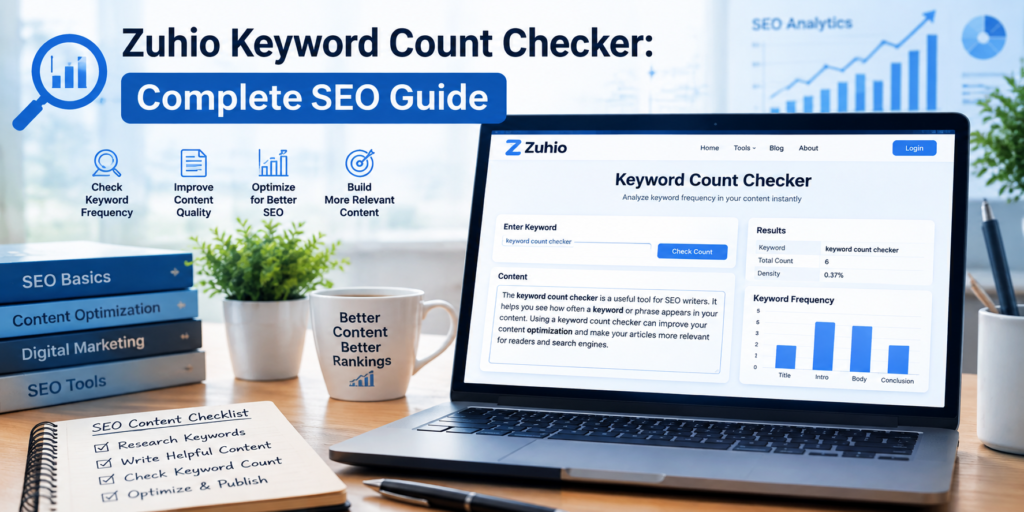
That is where a keyword frequency tool can be useful. Zuhio keyword count checker is designed around a simple idea: help users see how often a specific keyword or phrase appears in their content. The official Zuhio website describes the tool as a way to quickly analyze keyword frequency and understand keyword usage while creating more focused, SEO-friendly content.
If you are a blogger, SEO writer, content marketer, or website owner, this type of tool can give you a quick final check before publishing.
What Is a Zuhio Keyword Count Checker?
Zuhio keyword count checker is an online keyword analysis tool that helps you determine how many times a particular keyword or multi-word phrase appears in a piece of content. You can use the information to review keyword frequency, identify unnecessary repetition, and make your writing more natural. It is a focused content-checking utility rather than a complete SEO platform. The official site says users can paste content, enter a keyword, and receive results quickly.
summary
- Zuhio provides a focused keyword-counting tool.
- It helps identify how often a word or phrase appears.
- It supports individual keywords and multi-word phrases.
- You can paste content and analyze it without complicated setup.
- It is useful during the editing stage.
- Keyword frequency is only one part of SEO.
- Good content should prioritize readers rather than a fixed keyword number.
What Does Zuhio Do?
At its core, the tool focuses on keyword usage analysis.
The official Zuhio website lists several features related to keyword analysis, including instant keyword counting, keyword frequency insights, support for keyword phrases, and fast content analysis.
The basic process is straightforward:
- Prepare your article or page content.
- Enter the keyword or phrase you want to check.
- Run the analysis.
- Review how frequently the term appears.
- Edit the content if the wording feels excessive or unnatural.
- Check the revised version again.
This is especially useful when you have finished writing an article and want to perform a final optimization check.
Why Does Keyword Frequency Matter?
Keywords still have a practical role in helping search engines understand what a page discusses. Google recommends using words that people would use to search for your content and placing descriptive terms in useful locations such as titles, headings, and link text.
However, this does not mean you should repeat one phrase throughout an article.
Imagine you are writing a 2,000-word article about email marketing.
If the exact phrase appears only once, you may want to check whether the topic is clearly represented.
Now imagine that the exact phrase appears in nearly every paragraph. The content may begin to sound repetitive:
Email marketing is useful because email marketing helps businesses. Good email marketing strategies can improve email marketing results…
The problem is obvious to a human reader.
A frequency checker helps you spot this kind of repetition before publication.
The important point is that the tool provides data. It does not decide whether your content is genuinely helpful.
How to Use the Zuhio Keyword Count Checker
Using the tool is designed to be simple, even if you have little SEO experience. Zuhio states that users can paste their content, enter a keyword, and get results in seconds without complicated technical setup.
Step 1: Finish Your Draft
Write the article naturally first.
Do not stop after every paragraph to count your keyword. Doing so can make your writing mechanical.
A better workflow is:
Research → Write → Edit → Analyze → Improve → Publish
This keeps the reader’s needs at the center.
Step 2: Choose Your Target Phrase
Select the main search term you are targeting.
For example, if your article is about keyword research for small businesses, your primary phrase might be:
keyword research for small businesses
Do not automatically enter a single word if your actual target is a longer search phrase.
The official tool supports both individual keywords and multi-word phrases.
Step 3: Add Your Content
Paste the article into the analysis area.
For the most useful result, use the complete draft rather than checking one small paragraph.
A complete article gives you a better picture of how frequently your target term appears throughout the page.
Step 4: Run the Check
Start the analysis and review the result.
The main question is simple:
Does the keyword appear naturally for the reader?
Do not immediately change the article just because the number is higher or lower than a random SEO recommendation.
Step 5: Review the Context
This is the most important step.
Suppose your target phrase appears 12 times in a long article. That number alone does not tell you whether the content is good.
Look at where those mentions occur.
Are they:
- In the title?
- In the introduction?
- In a relevant heading?
- Naturally distributed through the article?
- Used where they actually make sense?
Or are they awkwardly inserted just to increase frequency?
Context matters more than blindly chasing a number.
When Should You Use a Keyword Counting Tool?
The best time is usually after the main draft is complete.
During writing, your primary goal should be clarity.
Afterward, you can use a frequency check as part of your editing process.
For example:
Before checking
You finish a 1,800-word software guide and feel that your target phrase might appear too often.
During the check
You discover that several headings and paragraphs repeat exactly the same wording.
During editing
You replace some repetitions with natural alternatives such as:
- keyword analysis tool
- search term
- target phrase
- primary keyword
- content analysis
- keyword frequency
- search query
- topic phrase
The result can be easier to read without changing the subject of the article.
Keyword Count vs. Keyword Density
These two concepts are related but not identical.
Keyword count means the number of times a particular term appears.
Keyword density expresses keyword usage in relation to the total amount of text.
For example, imagine a 1,500-word article contains a target phrase 15 times.
A simple density calculation would be:
15 ÷ 1,500 × 100 = 1%
The calculation itself is easy.
The difficult question is whether that percentage is appropriate for the page.
There is no universal keyword-density percentage that guarantees a Google ranking.
Google’s guidance emphasizes helpful, reliable, people-first content rather than writing to a particular word count or manipulating search systems.
So treat frequency and density as editing signals, not ranking targets.
Does a Higher Keyword Count Mean Better SEO?
No.
This is one of the biggest misunderstandings about keyword tools.
More mentions do not automatically mean better optimization.
Consider two articles about running shoes.
Article A
The primary phrase appears naturally throughout the article. The content compares shoe types, explains fit, discusses materials, and answers common buyer questions.
Article B
The same phrase is repeated in nearly every paragraph, even where it sounds unnatural.
Article B may have a higher keyword count, but that does not make it better.
Google specifically identifies excessive and unnatural repetition as keyword stuffing. Its spam policies explain that repeating words or phrases so often that the content sounds unnatural can violate its guidelines.
The goal should therefore be natural relevance, not maximum repetition.
How to Avoid Keyword Stuffing
Keyword stuffing happens when keywords are inserted mainly to manipulate search visibility rather than help readers.
Google gives examples of pages where words or phrases are repeated unnaturally or out of context.
A simple way to avoid the problem is to ask:
Would I write this sentence if search engines did not exist?
If the answer is no, rewrite it.
Use Semantic Variations
Instead of repeating one exact phrase, use related terminology where appropriate.
For a topic about SEO writing, related terms might include:
- search intent
- on-page SEO
- content optimization
- target keyword
- search query
- semantic relevance
- topical coverage
- organic search
- content quality
These terms can help you explain the subject naturally without making every sentence sound identical.
This is also better for readers because real people naturally use different words when discussing the same topic.
What Are the Main Features of Zuhio?
The official website highlights several functions of its keyword analysis tool.
| Feature | What It Helps With |
|---|---|
| Instant keyword counting | Quickly identifying keyword frequency |
| Frequency insights | Reviewing how often terms appear |
| Phrase support | Checking multi-word search terms |
| Fast analysis | Getting results without a complex workflow |
| Content optimization | Finding areas where wording may need improvement |
| SEO-focused use | Supporting writers and content professionals |
The platform describes itself more broadly as a collection of focused micro-tools designed to solve specific business and productivity problems.
That approach is different from a large SEO suite containing dozens of unrelated dashboards.
Who Can Benefit From This Tool?
A simple keyword analysis tool can be useful for several types of users.
Bloggers
Bloggers can check whether a target phrase appears naturally before publishing.
This can be particularly useful when an article has gone through several rounds of editing.
SEO Writers
SEO writers often work with detailed content briefs. A quick frequency check can help confirm that an assigned phrase has not accidentally been overused.
Content Marketers
Marketing teams can use keyword analysis during content reviews to catch obvious repetition before an article reaches publication.
Website Owners
Small business owners may not need an expensive SEO platform just to answer a basic question about word frequency.
A focused utility can be enough for a simple editing task.
Students and Researchers
People preparing informational reports can also use frequency analysis to identify repeated terms.
However, academic or confidential material should always be handled according to the relevant privacy and institutional requirements.
What Zuhio Does Not Replace
A keyword counter is useful, but it should not be confused with a complete SEO platform.
A comprehensive SEO process can involve many other areas, including:
- Search intent
- Keyword research
- Competitor analysis
- Technical SEO
- Internal linking
- Backlink analysis
- Page speed
- Structured data
- Content quality
- Search performance
- Conversion optimization
A frequency tool does not answer all of these questions.
For example, knowing that your target phrase appears 10 times does not tell you whether people actually want that content.
It also does not tell you whether your page provides a better answer than competing pages.
That is why keyword analysis should be treated as one small part of on-page SEO.
A Better SEO Workflow for Content Writers
If you regularly publish articles, consider using the tool near the end of a broader workflow.
1. Understand Search Intent
First, identify what the searcher actually wants.
Is the query informational, commercial, transactional, or navigational?
2. Research the Topic
Understand the subject before writing.
Look for important subtopics, questions, terminology, and practical examples.
3. Create the Outline
Build headings around genuine user needs rather than trying to place the target phrase into every heading.
4. Write Naturally
Focus on answering the searcher’s question.
5. Edit for Readability
Remove unnecessary sentences, repeated ideas, weak introductions, and awkward wording.
6. Check Keyword Frequency
Use a tool such as Zuhio as a final frequency check.
7. Improve Natural Language
Replace unnecessary exact-match repetitions with clear alternatives.
8. Review Links and Structure
Check internal links, external references, headings, images, and other on-page elements.
9. Publish
Once the content is useful, readable, accurate, and technically sound, publish it.
This workflow is stronger than starting with a target number of keyword mentions.
Is There a Perfect Keyword Density?
No.
You will often see SEO articles recommend a specific percentage, such as 1% or 2%. These numbers can be useful as rough reference points, but they should not be treated as universal rules.
A 1,000-word article and a 5,000-word article naturally require different amounts of terminology.
Likewise, a phrase that is central to a topic may naturally appear more often than a supporting term.
Google’s current guidance does not recommend creating content around a preferred word count or a fixed keyword-density formula. Instead, its people-first guidance focuses on useful, comprehensive, trustworthy content that satisfies the reader.
That is why a frequency checker should answer:
“How often did I use this phrase?”
It should not be expected to answer:
“Will this page rank?”
Those are completely different questions.
Practical Example for a US Website
Imagine a small plumbing company in Austin, Texas, publishes an article called “How to Prevent Frozen Pipes.”
The writer’s main phrase is:
frozen pipes
After completing the article, the writer checks the phrase frequency.
If the phrase appears naturally in the title, introduction, one or two headings, and relevant paragraphs, there may be no reason to add more.
The writer could then use related language such as:
- pipe freezing
- cold-weather plumbing
- winter pipe protection
- burst pipes
- plumbing maintenance
- freezing temperatures
The content remains focused on the same topic without sounding repetitive.
This is a much more useful approach than forcing the exact phrase into every paragraph.
Pros and Cons
Pros
Simple to Understand
The basic purpose is easy to understand even for beginners.
Focused Function
If you only need to check keyword frequency, a focused tool can be faster than opening a large SEO platform.
Supports Phrases
The official site says the tool can analyze both individual keywords and multi-word phrases.
Useful During Editing
It can help identify accidental repetition in a completed article.
No Complex SEO Knowledge Required
You do not need to understand technical SEO to understand the basic result.
Cons
Not a Complete SEO Solution
Keyword frequency is only one part of content optimization.
A Count Cannot Judge Quality
A tool can tell you how often a phrase appears, but it cannot fully determine whether your article answers the user’s question.
Frequency Can Be Misinterpreted
Users may become too focused on hitting an arbitrary number.
It Does Not Replace Human Editing
A sentence can be grammatically correct and still sound unnatural. Human review remains important.
How to Use Keyword Data Without Over-Optimizing
The safest approach is to use frequency information as a warning system.
If the number seems unusually high, read the article again.
Look for repeated sentences or phrases.
Then ask:
- Can I remove this mention?
- Can I use a natural synonym?
- Does the sentence actually need the exact phrase?
- Does this paragraph provide new information?
- Is the wording useful to the reader?
If the answer is no, edit it.
This approach follows Google’s broader recommendation to create content primarily for people rather than content designed mainly to manipulate search rankings.
Frequently Asked Questions
What is Zuhio keyword count checker used for?
The tool is used to determine how frequently a particular keyword or phrase appears in written content. Zuhio’s official website describes it as a fast way to analyze keyword usage and frequency, making it useful for writers and SEO professionals who want a quick content check before publishing.
It is best viewed as an editing aid rather than a complete SEO solution.
Is Zuhio keyword count checker free to use?
The official Zuhio website presents its keyword counter as an accessible online tool, but users should check the current tool page for any changes to availability or usage terms. The main platform describes its tools as practical, focused solutions designed to simplify everyday business tasks.
Always verify current terms directly on the official site before relying on a tool for professional workflows.
How do I check keyword frequency in an article?
Start with your finished article, enter the keyword or phrase you want to analyze, and run the check. Review the frequency and then inspect the actual sentences where the term appears. The goal is not simply to increase or decrease the number, but to make sure the wording remains natural and useful.
Does keyword density guarantee higher Google rankings?
No. Keyword density does not guarantee rankings. Google recommends people-first content that is helpful, reliable, and created to satisfy users rather than content designed primarily to manipulate search results.
A keyword count can help with editing, but rankings depend on many broader factors.
What is keyword stuffing?
Keyword stuffing is the practice of filling a webpage with keywords or numbers in an attempt to manipulate search rankings. Google specifically describes excessive repetition that makes content sound unnatural as an example of keyword stuffing.
Natural writing should always come before hitting a specific frequency target.
Should I check keywords while writing?
Usually, it is better to write the first draft naturally and perform frequency analysis during editing. Constantly checking the count while writing can encourage forced wording. Finish the article first, then use the data to identify repetition or gaps.
Can a keyword counter replace an SEO tool?
No. A keyword counter handles a narrow task. Full SEO platforms may provide keyword research, competitor data, technical audits, backlinks, rankings, content recommendations, and other functions. A simple counter can complement those tools, but it does not replace them.
Should every article have the same keyword frequency?
No. Different topics naturally use different terminology. A technical article may need to repeat certain terms more frequently than a general guide. Instead of using one fixed frequency for every page, focus on clarity, topic coverage, and natural language.
Is keyword counting still useful for modern SEO?
Yes, as an editing check. It can help writers detect accidental repetition and understand how frequently a phrase appears. However, it should not become the main SEO strategy. Modern content optimization should also consider search intent, helpfulness, topical coverage, internal links, readability, and overall page quality.
Final Verdict
The Zuhio keyword count checker is most useful when you want a quick answer to a simple question: “How often does this keyword or phrase appear in my content?”
That makes it practical for bloggers, SEO writers, marketers, and website owners who want a lightweight final check.
The key is knowing what the number means—and what it does not mean.
A keyword count can reveal repetition, but it cannot create useful content for you. Strong SEO starts with understanding the searcher’s needs, providing a complete answer, writing naturally, and using keywords where they genuinely belong.
Also read this: