
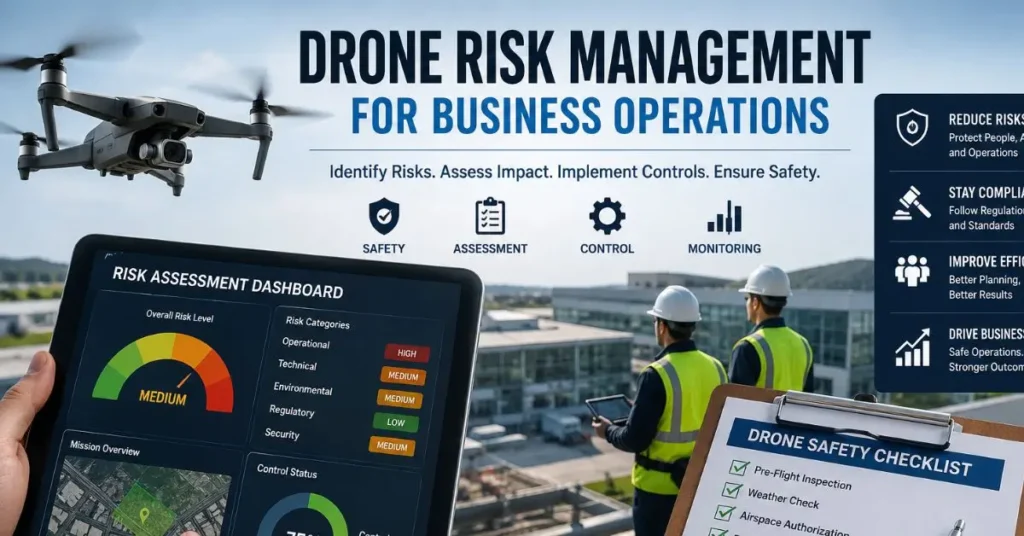

Introduction
Commercial drones have become valuable tools for businesses across the United States. Companies use them for inspections, construction monitoring, agriculture, mapping, photography, security, and asset management. While drones can improve efficiency and reduce costs, they also introduce new risks that organizations must control.
A single drone incident can lead to property damage, legal issues, operational disruptions, financial losses, or reputational harm. That is why businesses need a structured approach to managing these risks before launching any drone program.
Drone risk management is the process of identifying, assessing, reducing, and monitoring risks associated with drone operations. It combines safety planning, regulatory compliance, employee training, equipment maintenance, insurance coverage, and operational controls to help organizations operate drones safely and responsibly.
In this guide, you’ll learn the major risks businesses face, how to evaluate them, and practical steps to create a safer and more reliable drone program.
summary
- Business drones create operational, legal, safety, and financial risks.
- Risk assessment should happen before every mission.
- Pilot training and maintenance reduce incident rates.
- Compliance with aviation regulations is essential.
- Insurance provides additional protection.
- A structured safety framework helps businesses avoid costly mistakes.
Why Businesses Need a Risk Management Strategy
Many organizations focus on the benefits of drones but underestimate the potential consequences of a failed operation.
A drone crash may damage equipment, injure people, interrupt projects, or create legal liability. Even a minor incident can affect client trust and company reputation.
Businesses that operate drones regularly should treat them like any other critical business asset. Just as companies manage cybersecurity, workplace safety, and financial risks, drone operations require formal oversight.
A structured approach helps organizations:
- Improve operational safety
- Reduce financial exposure
- Protect employees and the public
- Maintain regulatory compliance
- Build customer confidence
- Minimize project delays
Common Risks Associated With Commercial Drone Operations
Understanding potential threats is the first step toward effective risk control.
Safety Risks
Safety risks are often the most visible concerns.
Examples include:
- Drone collisions
- Equipment failure
- Battery malfunctions
- Loss of signal
- Pilot error
- Flying near people
For example, a construction company using drones to inspect a building could face serious consequences if a drone loses power and falls onto an active worksite.
Explore more: Case Study Small Service Business Financing Success
Regulatory Risks
Drone operators must comply with aviation regulations and local requirements.
Potential issues include:
- Flying in restricted airspace
- Operating beyond authorized limits
- Lack of proper certification
- Failure to obtain required permissions
Regulatory violations can lead to fines, project interruptions, and legal complications.
Financial Risks
Drone incidents often create unexpected costs.
Examples include:
- Equipment replacement
- Legal expenses
- Insurance claims
- Project delays
- Lost contracts
Even a relatively small incident can become expensive when downtime and liability costs are considered.
Cybersecurity Risks
Modern drones rely heavily on software, GPS systems, wireless communication, and cloud-based platforms.
Potential concerns include:
- Data theft
- GPS spoofing
- Signal interference
- Unauthorized system access
Organizations handling sensitive information should pay particular attention to cybersecurity controls.
Reputational Risks
Customers expect businesses to operate safely and professionally.
A publicized incident can damage trust, especially if it involves injuries, privacy concerns, or regulatory violations.
Rebuilding credibility can take much longer than replacing damaged equipment.
The Core Process of Drone Risk Management
Successful programs follow a structured process rather than reacting to problems after they occur.
1. Identify Risks
Start by listing all possible hazards.
Consider:
- Weather conditions
- Airspace restrictions
- Nearby buildings
- Power lines
- Pedestrian traffic
- Equipment reliability
- Pilot experience
A detailed pre-flight review often reveals risks before they become serious issues.
2. Assess Risk Levels
Not every risk has the same impact.
Organizations should evaluate:
| Risk Factor | Questions to Ask |
|---|---|
| Likelihood | How likely is the event to occur? |
| Impact | What happens if it occurs? |
| Exposure | Who or what could be affected? |
| Control Measures | How effectively can it be reduced? |
This assessment helps prioritize resources and safety measures.
3. Implement Controls
Once risks are identified, appropriate controls should be introduced.
Examples include:
- Pilot training
- Flight planning software
- Geofencing
- Equipment inspections
- Emergency procedures
- Restricted operating zones
The goal is not to eliminate every risk, which is often impossible, but to reduce risk to an acceptable level.
More Read: How to Start an Online Coaching business
4. Monitor and Review
Risk conditions can change quickly.
New regulations, equipment upgrades, operational environments, and business requirements may create new challenges.
Regular reviews help keep safety programs effective.
Building a Business Drone Safety Program
A formal safety program provides consistency across operations.
Create Standard Operating Procedures
Every organization should document procedures covering:
- Flight planning
- Equipment checks
- Battery management
- Weather evaluation
- Emergency response
- Data management
Written procedures reduce confusion and improve accountability.
Conduct Pre-Flight Inspections
Many incidents can be prevented through simple inspections.
Check:
- Propellers
- Batteries
- Sensors
- GPS systems
- Firmware updates
- Communication links
A few minutes of inspection can prevent expensive failures.
Establish Emergency Plans
Even well-managed operations can experience unexpected events.
Emergency plans should address:
- Signal loss
- Flyaway incidents
- Battery failure
- Crash response
- Injuries
- Property damage
Teams should know exactly what to do before an emergency occurs.
The Importance of Pilot Training
Technology continues to improve, but pilot skill remains one of the most important factors in safe operations.
Training should cover:
- Airspace awareness
- Flight controls
- Emergency procedures
- Weather assessment
- Regulatory compliance
- Mission planning
Experienced pilots are generally better equipped to recognize and respond to changing conditions.
Ongoing education is equally important because regulations and technology evolve over time.
Weather Risk Assessment
Weather is one of the most common causes of drone-related incidents.
Conditions can change rapidly, especially in open environments.
Factors to evaluate include:
Wind Speed
Strong winds can reduce stability and battery efficiency.
Rain and Moisture
Many commercial drones are not designed for significant exposure to moisture.
Visibility
Poor visibility increases navigation challenges and situational risks.
Temperature
Extreme heat or cold may affect battery performance and equipment reliability.
Businesses should establish weather limits and avoid operations outside approved conditions.
Insurance and Risk Transfer
Insurance does not replace safety practices, but it provides important financial protection.
Coverage may include:
- Liability claims
- Property damage
- Equipment loss
- Personal injury
- Legal defense costs
Organizations should review policies carefully to understand coverage limitations.
Businesses conducting high-value inspections, infrastructure projects, or industrial operations often require more comprehensive protection than occasional drone users.
Data Security and Privacy Considerations
Many drones collect large amounts of information.
This may include:
- Photos
- Videos
- Mapping data
- Infrastructure information
- Customer property records
Businesses should establish clear policies for:
- Data storage
- Access controls
- Encryption
- Retention periods
- Data sharing
Strong governance helps reduce privacy and cybersecurity risks.
Real-World Example
Imagine a U.S. construction company using drones to monitor a large commercial project.
Without a formal safety program, pilots may fly without standardized procedures, increasing the chance of accidents.
After implementing a structured drone risk management framework, the company introduces:
- Pilot certification requirements
- Pre-flight inspections
- Weather assessments
- Flight logging
- Incident reporting
As a result, operational consistency improves and the likelihood of costly incidents decreases significantly.
Common Mistakes Businesses Should Avoid
Skipping Risk Assessments
Some teams become comfortable after repeated successful flights and stop performing detailed evaluations.
This creates unnecessary exposure.
Relying Only on Technology
Safety features are helpful but cannot replace good decision-making.
Human oversight remains essential.
Ignoring Maintenance
Small mechanical issues can develop into major failures if left unaddressed.
Inadequate Documentation
Poor record-keeping makes audits, investigations, and compliance reviews more difficult.
Lack of Ongoing Training
Skills can decline over time without regular practice and education.
Future Trends in Drone Safety
Drone technology continues to evolve.
Emerging developments include:
- AI-powered flight monitoring
- Automated hazard detection
- Remote fleet management
- Advanced geofencing
- Improved collision avoidance systems
These innovations may reduce operational risks, but organizations will still need strong governance, training, and oversight.
Technology works best when combined with effective management practices.
Frequently Asked Questions
What is drone risk management?
Drone risk management is the process of identifying, evaluating, and reducing risks associated with drone operations. It helps organizations operate safely while minimizing legal, financial, and operational exposure.
The process typically includes risk assessments, safety procedures, pilot training, maintenance programs, compliance monitoring, and emergency planning.
Why is risk assessment important before a drone flight?
Risk assessment helps identify hazards before takeoff and allows operators to implement appropriate safety measures. This reduces the chance of accidents, property damage, and regulatory violations.
Factors such as weather, airspace restrictions, nearby people, and equipment condition should always be reviewed.
Do businesses need insurance for commercial drone operations?
Most businesses benefit from drone insurance because accidents can result in significant costs. Insurance provides financial protection against liability claims, property damage, equipment loss, and legal expenses.
Coverage requirements vary depending on the industry and operational complexity.
How often should drones be inspected?
Drones should be inspected before every flight and undergo scheduled maintenance according to manufacturer recommendations. Regular inspections help identify wear, damage, or system issues before they lead to failures.
Consistent maintenance improves reliability and operational safety.
What are the biggest risks in commercial drone operations?
The most common risks include pilot error, equipment failure, weather conditions, regulatory violations, cybersecurity threats, and privacy concerns.
Organizations that address these risks proactively are generally better positioned for long-term operational success.
Trusted Source Suggestions
Drones offer businesses powerful capabilities, but they also introduce operational and legal responsibilities. Organizations that invest in planning, training, maintenance, compliance, and risk assessment are far more likely to achieve safe and successful outcomes.
A practical safety framework helps reduce incidents, protect assets, and support long-term business growth. Start with a simple assessment process and build stronger controls as your drone program expands.
Author Bio
Johan is a business technology writer who focuses on operational efficiency, risk management, emerging technologies, and compliance strategies. He has spent years researching how organizations adopt new tools while maintaining safety, reliability, and regulatory compliance. His work helps business leaders make informed decisions using practical, real-world guidance.
Content Review Note:
Review and update this article every 6–12 months to reflect changes in drone technology, aviation regulations, safety standards, and industry best practices.