
Introduction:
How to set activities small business The corporate scene of 2026 is no longer about who works the longest hours; it is about who directs their energy with the most surgical precision. You have certainly experienced the change if you own a small business. In the modern world, artificial intelligence driven automation is a fundamental need and human-centric value is the premium product.
Working with developing businesses over the years has shown me a repeating trend: founders sometimes confuse activity for advancement. They fill their calendars with meetings, emails, and firefighting, only to discover at the end of the quarter that the needle has not moved.
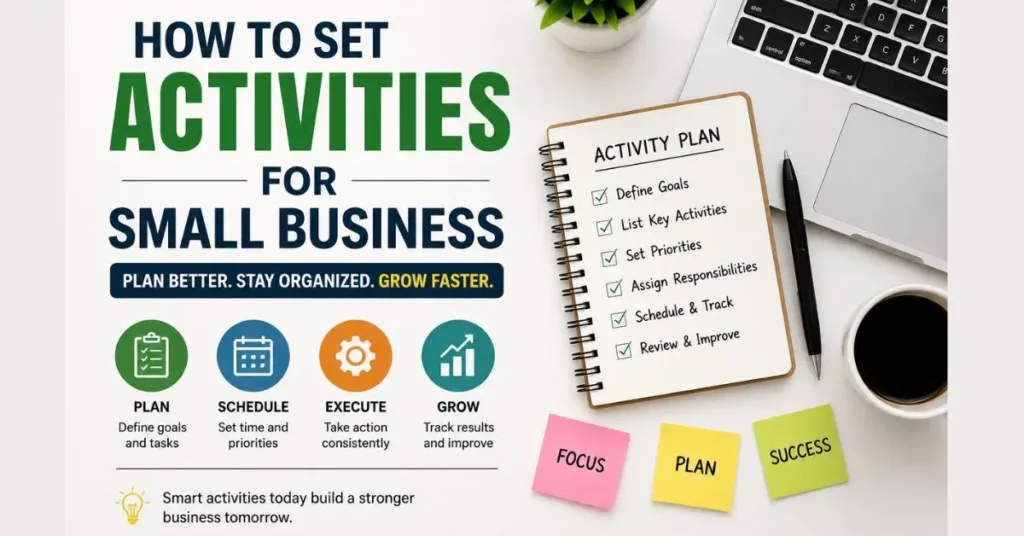
Learning how to set activities is about building a system in which every action supports a strategic objective, not simply creating a to-do list. This manual will show you how to rule your sector in 2026 by matching your everyday actions with high-level success.
Defining Business Goals: The North Star
Before you can decide what to do, you must know why you are doing it. In 2026, goals must be more than just “increasing revenue.” They need to be adaptive.
The Shift from SMART to AGIL
While SMART goals (Specific, Measurable, Achievable, Relevant, Time-bound) are a great foundation, I’ve found that the most successful small businesses now use AGIL goals:
-
Aligned: Does this activity match your core brand values?
-
Growth-Oriented: Does it scale, or is it a one-off task?
-
Iterative: Can you change course based on real-time data?
-
Lean: Does it maximize output while minimizing resource waste?
Identifying Your “One Thing”
Gary Keller’s concept of the “One Thing” is more relevant today than ever. Ask yourself: “What is the one activity such that by doing it, everything else becomes easier or unnecessary?” For a local bakery, it might be perfecting a subscription delivery model. For a tech consultant, it might be publishing a weekly authoritative white paper on AI implementation.
Planning Activities Effectively
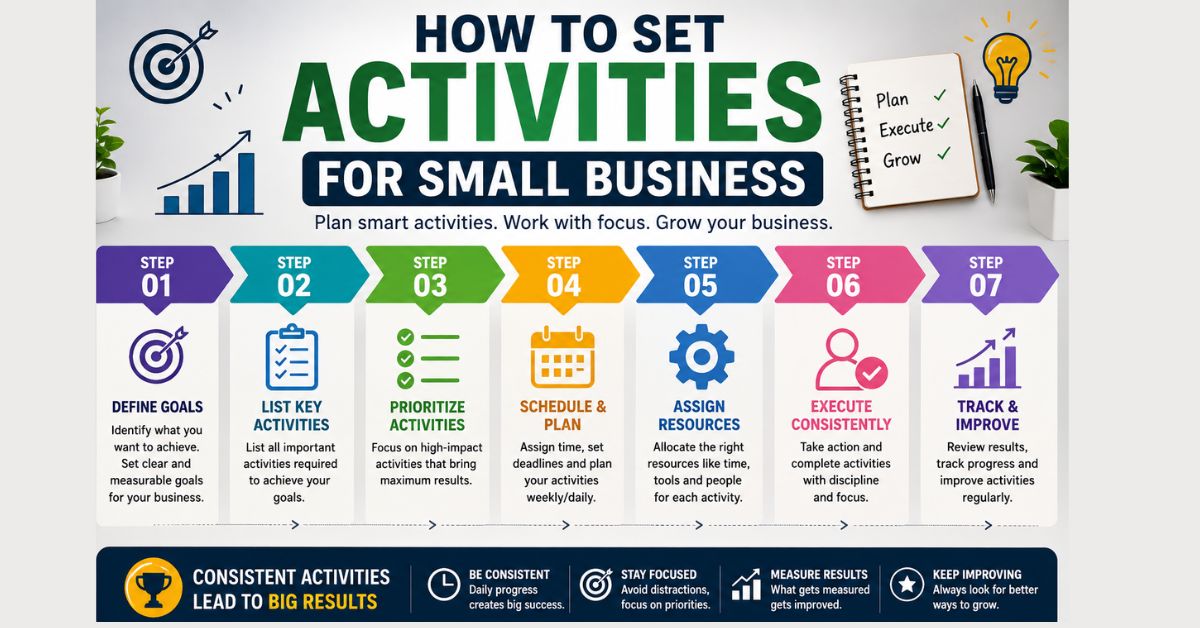
Planning is where strategy meets the calendar. In 2026, the hybrid work model and the rise of “asynchronous productivity” mean that rigid 9-to-5 schedules are often counterproductive.
The Three-Tier Planning System
I recommend a tiered approach to ensure you don’t get lost in the weeds:
-
Strategic (Annual/Quarterly): High-level shifts, such as entering a new market.
-
Operational (Monthly/Weekly): Projects that support the strategy, like launching a marketing campaign.
-
Tactical (Daily): The specific tasks required to complete projects.
Table 1: Activity Mapping for Small Business Growth
| Activity Level | Frequency | Focus Area | Example |
| Strategic | Quarterly | Market Positioning | Analyzing competitor AI integration |
| Operational | Monthly | Funnel Optimization | Refining the lead-nurturing email sequence |
| Tactical | Daily | Execution & Service | Responding to high-value client inquiries |
| Administrative | Weekly | Maintenance | Auditing automated billing systems |
Prioritizing High-Impact Tasks
In my experience, the biggest killer of small businesses isn’t a lack of ideas—it’s a lack of focus. You have to be ruthless about what makes the cut.
The Eisenhower Matrix 2.0
We all know the “Urgent vs. Important” box, but in 2026, we add a third dimension: Automate-ability.
-
Quadrant 1: High Importance/High Urgency. Do these now (e.g., a server crash or a major client issue).
-
Quadrant 2: High Importance/Low Urgency. This is where growth lives (e.g., relationship building, long-term planning).
-
Quadrant 3: Low Importance/High Urgency. Delegate these to your team or AI agents.
-
Quadrant 4: Low Importance/Low Urgency. Delete these.
The Pareto Principle (80/20 Rule)
Identify the 20% of your activities that drive 80% of your results. For many of my clients, this is often “Deep Work” sessions—uninterrupted blocks of 90 to 120 minutes where they tackle the most complex problems of the business.
Workflow and Accountability
A plan is only as good as its execution. To ensure activities are completed, you need a workflow that creates a “path of least resistance.”
Establishing Standard Operating Procedures (SOPs)
If you do a task more than three times, write down how you do it—or better yet, record a quick video. In 2026, SOPs are the “code” that runs your business. When you have clear instructions, you can delegate with confidence, knowing the quality will remain consistent.
The Role of Accountability
Whether you have a team of ten or you are a solopreneur, accountability is non-negotiable.
-
For Teams: Use weekly “Pulse Meetings” (15 minutes) to discuss what was done, what’s next, and where the bottlenecks are.
-
For Solopreneurs: I highly recommend an accountability partner or a mastermind group. Having someone to answer to changes your psychological commitment to your tasks.
Using Technology and Tools
We cannot talk about 2026 without discussing the tech stack. The goal of technology shouldn’t be to give you more to do, but to free you from the mundane.
The 2026 Small Business Tech Stack
The most successful businesses are moving away from “siloed” apps and toward unified ecosystems.
More: Robthecoins Business: Complete Guide and Tips
Table 2: Essential Tool Categories for 2026
| Category | Purpose | Example Tools (2026 Trends) |
| AI Orchestration | Managing multiple AI agents for content and data | AutoGPT-style wrappers, Zapier Central |
| Project Management | Visualizing workflows and deadlines | Notion (AI-integrated), Monday.com |
| CRM & Personalization | Managing deep client relationships | HubSpot with predictive churn analytics |
| Communication | Reducing “meeting fatigue” | Slack, Loom, or VR-collaborative spaces |
| Financial Intelligence | Real-time cash flow forecasting | Bench or Quickbooks with AI insights |
Pro Tip: Don’t adopt a tool just because it’s trendy. If a pencil and paper are faster for your initial brainstorming, use them. Technology should be a servant, not a master.
6. Monitoring and Improving Performance
How do you know if your set activities are actually working? You need a feedback loop.
Key Performance Indicators (KPIs) that Matter
Forget “vanity metrics” like social media likes. In 2026, focus on:
-
Customer Lifetime Value (LTV): How much is a customer worth over the long haul?
-
Customer Acquisition Cost (CAC): How much does it cost to get them?
-
Net Promoter Score (NPS): How likely are they to recommend you?
-
Activity Completion Rate: Are you actually doing what you said you would?
Monthly Performance Reviews
I block out the last Friday of every month to look at the data. I ask: “Which activity yielded the highest ROI? Which one felt like pushing a boulder uphill?” If an activity isn’t performing, don’t be afraid to kill it. “Sunk cost” is a trap that keeps small businesses small.
Risk Management Strategies
Small businesses are more agile than corporations, but they are also more vulnerable. Setting activities for success must include “defensive” tasks.
visit :Genesis Chiropractic Software: A Complete Review for Clinics
Diversification of Activities
Don’t put all your marketing eggs in one basket. If your primary activity is “Instagram Ads,” what happens if the algorithm changes or the platform loses relevance?
-
Activity: Build an owned audience (email list, SMS, or private community).
-
Activity: Invest in “Evergreen” SEO content that lives on your own domain.
The “Pre-Mortem” Exercise
Before launching a new set of activities, I like to do a “Pre-Mortem.” Imagine it is six months from now and the project has failed. Why did it fail? By identifying risks early—such as supply chain issues or a team member leaving—you can build “counter-activities” into your plan to prevent those failures.
Conclusion:
Learning how to plan events for the growth of a small business in 2026 is not about intricacy; it is about simplicity.
It‘s about having the self-control to reject a thousand good ideas in order to say yes to the three fantastic ones. The goal is to use the amazing AI technologies at our disposal to manage the mundane so that we can concentrate our human efforts on innovation, empathy, and strategy.
Begin little. Consult your calendar for the following week. Find one low-impact activity you may get rid of and one high-impact activity you have been putting off. Execute that deal now. Your future self will thank you; your bottom line will thank you.
FAQs
How do I know if I’m focusing on the “wrong” activities?
The clearest sign is a lack of correlation between effort and results. If you are working 60 hours a week but your revenue or client satisfaction isn’t moving, you are likely stuck in Quadrant 3 (Urgent but not Important) tasks. Audit your time for one week to see where the hours are actually going.
Is AI going to replace the need for setting manual activities?
AI will replace the execution of many manual activities, but it cannot replace the selection of those activities. As a business owner, your job is moving from “Worker” to “Architect.” You must still decide the direction and the desired outcome.
How often should I update my business goals?
In the fast-paced market of 2026, I recommend a “rolling” strategy. Review your tactical goals weekly, your operational goals monthly, and your high-level strategy every quarter. Annual plans are now “loose guides” rather than rigid scripts.
What is the biggest mistake small businesses make when planning?
Over-commitment. Most founders overestimate what they can do in a day and underestimate what they can do in a year. Picking too many “priority” activities results in none of them being done well. Limit yourself to three major objectives per quarter.
Can I use these strategies if I’m a solopreneur?
Absolutely. In fact, these strategies are more vital for solopreneurs because you have no one to delegate to. Efficiency and prioritization are your only ways to scale without burning out.
References
-
The 4-Hour Workweek by Timothy Ferriss (Principles of Automation and Elimination).
-
Atomic Habits by James Clear (Building systems for activity execution).
-
Essentialism: The Disciplined Pursuit of Less by Greg McKeown.
-
Harvard Business Review: The Secrets to Successful Strategy Execution.
-
Small Business Administration (SBA) 2026 Growth Projections and Digital Trends.